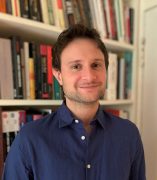
Bert Geyer
PhD Student
Email:
About
Bert Geyer’s broad interest is the role of form in historiography, which has led him to examine the novel forms contemporary art offers for grasping history, presence, and futurity. Stemming from his prior training and practice as a sculptor, Bert also maintains immersion in the material culture and political economy of trees and wood. His current research tracks the rhetorical conventions and bureaucratic behaviors through which Progressive Era U.S. forestry cultivated an oneiric vision of forests as troves of productive potential awaiting actualization by rational management. It proceeds with the heuristic that these tropes constitute an aesthetic mode—imagining developmental progress as a form of experiential pleasure. Through archival examination of forestry projects in the Midwest, Philippines, and Caribbean, it seeks to comparatively demonstrate the necessarily imperial conditions of possibility for this aesthetic mode. Further, with an eye toward the present, it foregrounds the aesthetic dimension suffused through calculations of political economy and thus attends to form for discerning the treacherous pleasures of speculation and those presences it cannot bring into ratio.
Bert completed an MFA while in the Sculpture Department at the School of the Art Institute of Chicago and a BA in Art at Rhodes College. He recently received the University Fellowship from UIC and the Alfred D. Bell Jr. Travel Grant from the Forest History Society. He has published art criticism in The Seen Journal and Chicago Artist Writers and his artist’s book, composite stoke where, is held in the Joan Flasch Artist’s Book Collection at the Flaxman Library. Before arriving at UIC, Bert taught as a Lecturer in the Art & Design Department at Chicago State University and the Instructional Facilities Supervisor in the Sullivan Fabrication Studio at the School of the Art Institute of Chicago.